
Green think tank Centre for Science and Environment (CSE) said the ongoing smog episode is a public health emergency.
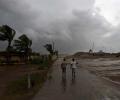
The IMD has warned of squally winds speed reaching 45-55 kmph gusting to 65 kmph likely to commence along and off Odisha and north coastal Andhra Pradesh coasts from October 27 onwards.

The area under paddy - the biggest foodgrain during the kharif season - was almost 13 per cent lower in the week ended August 5 as compared to the same period last year despite a slight pick-up in rains in the main growing regions, triggering fears of a 10-12 million-tonne drop in final output. Sources said with the peak sowing season for paddy almost coming to an end in the big-growing states, any uptick in coverage from here onwards may not give the desired yields. With 30 per cent of normal average area in which paddy is grown every year remaining unsown till early August, there is a limited chance of a big uptick in output, trade and market sources said.

Meanwhile, water will be released from Chembarambakkam lake, one of the key drinking water sources to Chennai, since it was nearing capacity, the government said.

'It is the most prone month for the development of cyclones in the pre-monsoon period.'
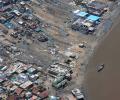
As many as 45 people have been killed due to cyclone Tauktae across 12 districts of Gujarat, officials.

The smog reduced the visibility to merely 300 meters in the morning affecting traffic, an official of the India Meteorological Department said.

The cyclone would bring light to moderate rains at most places and 'heavy to very heavy downpour' at some places on November 6.

The India Meteorological Department, which had issued a red colour-coded alert for north India for May 25-26 when the prevailing heatwave conditions are expected to peak, said dust and thunderstorms are likely to bring some relief on May 29-30.
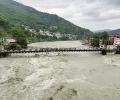
Incessant rains unleashed more death and destruction on Monday in parts of north India, with 37 people killed in landslides and other rain-related incidents in the last two days even as the Army and NDRF teams stepped in to intensify the relief and rescue operations.

The UNICEF said an estimated 2.4 million children have been affected by the recent floods in the country.

The two western states, already battling a raging pandemic, which has put their health infrastructure under severe strain, opened new fronts to tackle the fallout of the storm which is expected to make a landfall close to Mumbai on Wednesday. They are likely to be impacted most by the cyclone.

It has also advanced into most parts of Tamil Nadu, some parts of south interior Karnataka and remaining parts of south Bay of Bengal, according to IMD.
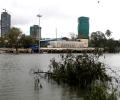
However, some areas in south Mumbai, which witnessed a record rain on Wednesday, were still water-logged, they said. The India Meteorological Department (IMD) has predicted moderate to heavy rainfall in the city and suburbs and intense showers in some parts of the Mumbai Metropolitan Region in next 24 hours.

The Indian Meteorological Department, meanwhile, warned of intense spell of 30 to 50 mm rainfall per hour with strong winds in Mumbai and suburban areas.

The Centre will review the situation on a fortnightly basis.
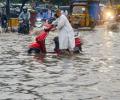
'Southwest Monsoon has advanced into remaining parts of Rajasthan, Haryana and Punjab and thus it has covered the entire country today, the 26th June 2020,' the IMD said in its special Daily Weather Report.

Tropical storm 'Tauktae' (pronounced as Tau'Te) which had intensified into a very severe cyclonic storm, lies close to the Gujarat coast, the India Meteorological Department said. "The landfall process has started and will continue during next two hours," the IMD said.

Even as Tauktae's intensity weakened, it left behind a trail of destruction with as many as 13 people losing their lives in different parts of Gujarat, including Bhavnagar, Rajkot, Patan, Amreli and Valsad, officials said.

The weatherman said when 'Amphan' makes the landfall between West Bengal's Digha, some 180 km from Kolkata, and Hatiya island in Bangladesh on Wednesday afternoon or evening, it will pack sustained wind speed of 155 to 165 kmph, gusting at 185 kmph. The gale-force wind, blowing at a speed of 240 to 250 kmph and gusting to 275 kmph at one point, had lost intensity and was moving at a speed of 200 to 210 kmph, gusting to 230 kmph on Tuesday evening.

Of that figure, a whopping 4,246 people died in Andhra Pradesh and Telangana alone.

The deep depression in the Arabian Sea has intensified into cyclonic storm "Ashobaa" and is expected to further develop into a "super cyclonic storm" in next 24-36 hours, the weather office said on Monday.

Large swathes of the country reeled under heatwave conditions on Tuesday with Churu in Rajasthan recording a high of 48 degree Celsius.

The deep depression in North Andaman Sea and its neighbourhood intensified into a cyclonic storm on Wednesday and is likely to cross Andhra Pradesh and Odisha coast on October 12.

The maximum death toll has been reported from Idukki district, where 43 people have lost their lives so far, as per official estimates. 28 deaths were reported in Malappuram and 27 in Thrissur.

Scientists at the India Meteorological Department warn that not only has India turned hotter in the last two decades, but that heat waves are projected to become more intense, have longer durations and greater frequency, thereby resulting in more deaths.

As Cyclone Hudhud is closing in on the Andhra Pradesh coastline and is expected to make a landfall near Visakhapatnam by Sunday afternoon, about 1.11 lakh people in five coastal districts have been shifted to safer places.

No immediate relief appears in sight as the India Meteorological Department issued a red alert for six districts which have been already pounded by downpour, forecasting "extremely heavy" rainfall and recommending preventive actions.

Suburban services were disrupted with trains on all the three lines -- western, central and harbour -- running late.

While man and a woman were reported killed when trees came crashing down on them in North 24 Parganas district of West Bengal, a 13-year-old girl died in a similar incident in adjoining Howrah. No casualties have been reported from Odisha yet.

A 58-year-old man died after a power transformer fell on him in Raigad district. 2 people died and 3 were injured in two separate cyclone-related incidents in Pune.

'It affects our economy, it is very important in many ways.' 'So we have to be the foremost experts in the world on the monsoon.' 'But the best minds in India have not devoted their time to the study of monsoon and they have followed the fashions of the West.'

A new 7.3-magnitude earthquake and seven powerful aftershocks struck Nepal on Tuesday killing at least 50 people and triggering panic in the Himalayan nation already devastated by a monster temblor less than three weeks ago that had claimed over 8,000 lives.

Around six lakh people have been housed in over 2000 relief camps in the two states.

The current crisis Karnataka Chief Minister Siddaramaiah is facing is a cumulative effect of inattention to water management and the fiscal burden of populist promises, says Aditi Phadnis.

'All El Ninos are not associated with the deficient monsoon.'

'Evacuation' has been key to disaster management in Odisha. The aim is to achieve zero casualty.

Binu Alex, co-founder and editorial director of www.commodityonline.com, in an interview to Syed Firdaus Ashraf/Rediff.com, says demand-supply imbalance arising out of the government's inability to preserve the crop for non-harvesting season is the root cause behind the price rise.
